
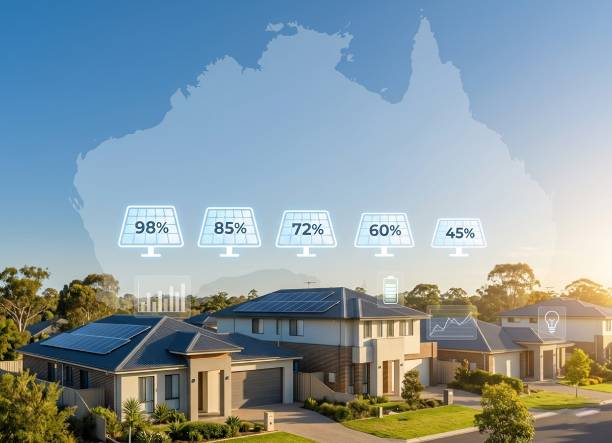
If you’re searching for the best solar panels for your Australian home in 2026, you’re not alone. With electricity prices continuing to rise across the country, more Australians than ever are switching to solar. However, with over 8,500 panel models from more than 150 brands currently listed on the Clean Energy Council’s approved product list, knowing which one to choose can feel overwhelming.
This guide cuts through the noise. We compare the top 5 solar panels available in Australia right now – covering efficiency, warranty, degradation rate, temperature performance, and value for money. Whether you’re in Sydney, Melbourne, Brisbane, Perth, or Adelaide, this comparison helps you make a confident, informed decision.
Why Choosing the Best Solar Panels Matters in 2026
Solar panels are a long-term investment. Most quality systems are designed to last 25 to 30 years. Therefore, the panel you choose today will directly affect how much energy you generate – and how much money you save – for the next three decades.
The gap between a premium panel and a budget one isn’t always obvious on day one. However, over 25 years, a panel with a lower degradation rate and higher efficiency can generate thousands of dollars more in electricity savings. That difference is often far greater than the additional upfront cost of choosing a better brand.
Also, solar technology in 2026 has advanced significantly compared to just five years ago. Modern panels are more efficient, more durable, and better equipped to handle Australia’s unique climate challenges, including intense heat, strong UV, salt air in coastal areas, and storm conditions.
Choosing the right panel from the start means fewer headaches, better returns, and greater peace of mind over the life of your system.
What to Look for When Comparing Solar Panels in Australia
Not all solar panels are created equal. Several key factors separate the best solar panels from the rest. Understanding these will help you compare brands with confidence.
Efficiency: More Power from Less Roof Space
Efficiency measures how much of the sunlight hitting your panel is converted into usable electricity. A panel rated at 22% efficiency converts 22% of the solar energy it receives into power.
This matters most when your roof space is limited. For example, a 22% efficient panel produces approximately 10% more power per square metre than a 20% efficient panel. Over a 6.6 kW system, that can translate to meaningful additional generation every day.
In 2026, the most efficient residential solar panels in Australia exceed 23% module efficiency. Leading N-type brands such as REC, SunPower, LONGi, and Jinko achieve between 22% and 24% efficiency under standard test conditions. A standard efficiency for a good quality mid-range panel currently sits around 21% to 22%.
Warranty: Product vs Performance – Know the Difference
Every solar panel comes with two distinct warranties, and understanding the difference is critical.
The product warranty (also called a manufacturing or materials warranty) guarantees that the physical panel will function without defects for a set number of years. It covers issues such as delamination, cell cracking, and frame failure. Product warranties typically range from 10 to 40 years, depending on the brand.
The performance warranty guarantees a minimum output level over time. For example, a panel with a 25-year performance warranty might guarantee it will still produce at least 84% of its original rated power after 25 years.
A longer warranty is meaningful only if the manufacturer has a stable Australian presence. A 30-year warranty from a company with no local office is worth far less than a 25-year warranty backed by a brand with Australian stock, a claims process, and a local support team.
Degradation Rate: The Hidden Factor That Affects Your Savings
All solar panels gradually lose a small amount of their output each year. This is called the degradation rate, and it varies significantly between brands.
The difference between a 0.25% and a 0.55% annual degradation rate sounds small. However, after 25 years, a panel degrading at 0.25% per year still produces 93.75% of its original output. A panel degrading at 0.55% per year produces only 86.25%. For a 6.6 kW system, that gap can represent $2,000 to $3,000 in lost generation over the system’s lifetime.
Premium panels from REC and SunPower degrade at around 0.25% per year. Mid-range options from Trina, LONGi, and Jinko typically range from 0.35% to 0.45% per year. Always check the performance warranty to understand the guaranteed minimum output over time.
Temperature Coefficient: Why It Matters in Australia’s Climate
The temperature coefficient measures how much a panel’s output drops for every degree above 25°C. On a hot Australian summer day, rooftop panels can reach temperatures of 60°C to 75°C.
A panel with a temperature coefficient of -0.30% per °C will lose 0.30% of its output for every degree above 25°C. At 65°C, that panel is operating at 88% of its rated capacity. A panel with a higher coefficient of -0.45% per °C would be operating at only 82% under the same conditions.
In climates like Queensland, Western Australia, and South Australia – where summer temperatures are extreme – a lower temperature coefficient makes a meaningful difference to your daily energy output. N-type panels consistently outperform older P-type technology in this area.
Tier 1 Status and Local Australian Support
You may see panels marketed as “Tier 1.” This classification comes from Bloomberg New Energy Finance (BNEF) and relates to the manufacturer’s financial stability and bankability, not panel quality directly.
However, Tier 1 status still matters because it indicates the manufacturer is financially stable enough to honour long-term warranties. A company that goes out of business cannot honour a 25-year warranty, regardless of how good the panels were when they were installed.
Beyond Tier 1, always check whether a brand has a local Australian office, Australian stock, and an established warranty claims process. This is what separates a credible long-term investment from a risk.
Top 5 Best Solar Panels in Australia 2026 – Full Comparison
The panels below are ranked based on a combination of efficiency, warranty quality, degradation rate, temperature performance, Australian market presence, and overall value for homeowners. All five are Tier 1 rated with proven track records in Australian conditions.
1. REC Alpha Pure-RX – Best Overall Solar Panel in Australia
The REC Alpha Pure-RX is widely regarded by Australian solar professionals as the gold standard in the mid-to-premium market. It consistently earns top marks across all the criteria that matter most for Australian homeowners – efficiency, temperature performance, durability, and warranty.
REC is a Norwegian-founded brand that now manufactures in Singapore. The Alpha Pure-RX uses Heterojunction Technology (HJT), a premium cell design that delivers outstanding performance in high-heat conditions. It is also lead-free in construction, which reflects the brand’s commitment to sustainability and reduces long-term environmental risk.
One of the standout features of the REC Alpha Pure-RX is its glass-glass construction with a double-glass design rather than a plastic backsheet. This makes it significantly more durable in harsh Australian conditions, including coastal salt air, high humidity, and strong UV exposure. The double-glass design also dissipates heat more effectively, which contributes to better real-world performance on hot days.
Australian solar installers consistently rate REC among the top performers for low-light generation. This means that on overcast days – common in Melbourne and Sydney during winter – REC panels continue to generate electricity more efficiently than many competitors.
The Alpha Pure-RX also carries one of the industry’s strongest degradation rates. Combined with its excellent temperature coefficient, it is an exceptional long-term performer. If you plan to stay in your home for 20 or more years and want the best possible return on your solar investment, the REC Alpha Pure-RX is the panel most experts would recommend.
REC Alpha Pure-RX: Key Specs at a Glance
| Specification | All Australian climates, premium performance seekers |
| Cell Technology | N-type HJT (Heterojunction) |
| Module Efficiency | Up to 22.3% |
| Power Output | 470W |
| Product Warranty | 25 years |
| Performance Warranty | 25 years |
| Annual Degradation | ~0.25% per year |
| Temperature Coefficient | -0.24% / °C |
| Price Range | $0.44 – $0.55 per watt |
| Best For | All Australian climates; premium performance seekers |
Who should choose REC Alpha Pure-RX?
This panel is ideal for homeowners who want the best long-term return, have limited roof space, or live in a coastal or high-heat environment. It sits at the premium end of the mid-range price bracket, but its superior efficiency, degradation rate, and temperature performance make it worth the extra investment for most homes.
2. SunPower Maxeon 6 – Best Premium Solar Panel in Australia
SunPower, now operating under the Maxeon brand for its premium panel range, consistently sets the benchmark for what is possible in residential solar technology. The Maxeon 6 is one of the most technically advanced solar panels available in Australia today.
The Maxeon series uses a unique Interdigitated Back Contact (IBC) cell design, which removes all electrical contacts from the front surface of the panel. This allows more sunlight to reach the active cell area, boosting both efficiency and long-term durability. Without exposed contacts on the front surface, the most common failure points in conventional panels are eliminated entirely.
What truly sets the SunPower Maxeon apart is its warranty. SunPower offers the longest warranty available on any solar panel sold in Australia: 40 years on both the product and the performance. The panels are guaranteed to produce a minimum of 88% of their original output after 40 years. No other brand comes close to this level of long-term commitment.
Efficiency is equally impressive. The Maxeon 6 achieves up to 22.8% module efficiency, and the broader Maxeon range reaches up to 24.1% in the most advanced models. This makes SunPower the ideal choice for homes with limited north-facing roof space, where maximising power output per square metre is essential.
The main trade-off is price. SunPower Maxeon panels are among the most expensive options in the Australian market. However, for homeowners who want the absolute best performance, the longest warranty certainty, and the lowest lifetime cost, the Maxeon 6 is in a class of its own.
It is worth noting that SunPower has changed ownership and corporate structure in recent years. Before purchasing, confirm that your installer can provide clarity on local warranty support and claims processes in Australia.
SunPower Maxeon 6: Key Specs at a Glance
| Specification | Detail |
| Cell Technology | N-type IBC (Interdigitated Back Contact) |
| Module Efficiency | Up to 22.8% |
| Power Output | 445W |
| Product Warranty | 40 years |
| Performance Warranty | 40 years |
| Annual Degradation | ~0.25% per year |
| Temperature Coefficient | -0.27% / °C |
| Price Range | $0.50 – $0.65 per watt |
| Best For | Limited roof space; maximum long-term performance |
Who should choose SunPower Maxeon 6?
Homeowners with a small or partially shaded roof, those who plan to stay in the property long-term, and buyers who prioritise absolute quality and the longest warranty protection will find SunPower Maxeon hard to beat. Budget is the primary consideration – this is a premium product at a premium price.
3. Trina Vertex S+ – Best Value Solar Panel for Australian Homes
If you’re looking for the sweet spot between performance and price, the Trina Vertex S+ is the answer. It is consistently one of the most popular solar panels installed in Australia in 2026, and for very good reason.
Trina Solar has been manufacturing panels since 1997 – nearly three decades of production experience. That longevity matters. The Vertex S+ uses N-type TOPCon (Tunnel Oxide Passivated Contact) cell technology, the newest mainstream solar technology in 2026. TOPCon cells deliver better efficiency, lower degradation, and superior hot-weather performance compared to older P-type PERC panels.
The Vertex S+ achieves approximately 22% module efficiency at 440W output – outstanding for its price bracket. Critically, it carries a 30-year performance warranty, which is five years longer than its 25-year product warranty. This unusual arrangement signals strong manufacturer confidence in the panel’s long-term output.
Trina has a Melbourne office, strong Australian distribution, and established installer familiarity across all states. Warranty support is therefore not a concern. Installers report excellent product availability and a reliable claims process.
At approximately $0.27 to $0.35 per watt, the Trina Vertex S+ delivers genuinely impressive efficiency at one of the most competitive price points of any Tier 1 N-type panel in Australia. For most Australian households with standard roof space and a typical energy usage pattern, this panel represents outstanding value.
Consider this example: A Brisbane family installs a 6.6 kW system using Trina Vertex S+ panels at a total cost of approximately $5,800 after the federal solar rebate. The system generates enough energy to reduce their electricity bill by approximately $1,500 per year, achieving payback in under four years.
Trina Vertex S+: Key Specs at a Glance
| Specification | Detail |
| Cell Technology | N-type TOPCon |
| Module Efficiency | ~22.0% |
| Power Output | 440W |
| Product Warranty | 25 years |
| Performance Warranty | 30 years |
| Annual Degradation | ~0.40% per year |
| Temperature Coefficient | -0.29% / °C |
| Price Range | $0.27 – $0.35 per watt |
| Best For | Value-conscious homeowners; most Australian roof types |
Who should choose Trina Vertex S+?
This panel is the go-to recommendation for the majority of Australian homeowners. It offers N-type technology, a strong warranty, good efficiency, and Tier 1 reliability at a price point that makes the financial case for solar compelling without the wait.
4. Jinko Tiger Neo – Most Affordable Tier 1 Solar Panel
Jinko Solar is the world’s most-shipped solar panel manufacturer by volume. That scale gives Jinko an enormous advantage in quality control and pricing. The Tiger Neo is their flagship N-type residential offering, and it is one of the most widely installed panels in Australia in 2026.
The Tiger Neo uses N-type TOPCon technology – the same advanced cell type found in more expensive panels – at a price point that makes it highly accessible for budget-conscious households. It achieves approximately 21.5% module efficiency, which is solid performance for its price tier.
Jinko panels are well-known for their excellent performance in high-temperature environments. The Tiger Neo’s temperature coefficient is competitive, making it a strong choice for Queensland, Western Australia, and South Australia, where summer roof temperatures regularly exceed 60°C.
The 25-year product warranty and 30-year performance warranty are competitive for the price. Jinko also has a strong Australian presence with local distribution infrastructure, which supports efficient warranty processing.
The trade-off compared to REC or SunPower is a slightly higher degradation rate of approximately 0.40% to 0.45% per year. Over 25 years, this means a Jinko Tiger Neo system will produce a little less total energy than a premium REC system of the same size. However, the upfront cost saving often more than compensates for this difference over a typical payback period.
For homeowners who want a reliable, proven Tier 1 N-type panel at the lowest possible price, the Jinko Tiger Neo is the clear choice.
Jinko Tiger Neo: Key Specs at a Glance
| Specification | Detail |
| Cell Technology | N-type TOPCon |
| Module Efficiency | ~21.5% |
| Power Output | 435W |
| Product Warranty | 25 years |
| Performance Warranty | 30 years |
| Annual Degradation | ~0.40–0.45% per year |
| Temperature Coefficient | -0.30% / °C |
| Price Range | $0.27 – $0.38 per watt |
| Best For | Budget-focused buyers; high-temperature climates |
Who should choose Jinko Tiger Neo?
First-time solar buyers, renters who have just purchased a home, or those working with a tighter budget will find the Jinko Tiger Neo to be an excellent, reliable choice. It delivers modern N-type technology at an entry-level price point with solid warranty backing.
5. LONGi Hi-MO 7 – Best Mid-Range Solar Panel in Australia
LONGi Solar is the world’s largest solar panel manufacturer by production capacity. The Hi-MO 7 is their current flagship residential product and sits comfortably in the mid-range category – offering performance that rivals premium brands at a price closer to the budget tier.
The Hi-MO 7 uses advanced back-contact cell technology (also known as HPBC – Hybrid Passivated Back Contact), which improves performance in diffuse light conditions. This makes it a particularly strong performer in southern states like Victoria and Tasmania, where winter overcast conditions are common. However, it performs equally well in Queensland and WA during summer.
LONGi achieves approximately 22.5% module efficiency with the Hi-MO 7, placing it just below REC in raw efficiency terms. Importantly, it has a moderate degradation rate of approximately 0.40% per year – good for its price tier, though not quite matching the ultra-low degradation of REC or SunPower.
LONGi has a well-established Australian office in Sydney and a strong warranty claims process backed by local stock. For Australian homeowners who want high performance without paying the absolute top-shelf price, the Hi-MO 7 strikes an excellent balance.
At approximately $0.35 to $0.50 per watt, it costs more than Trina and Jinko but delivers meaningfully better efficiency and brand confidence. Many experienced Australian solar installers consider the LONGi Hi-MO 7 the pick for buyers who want above-average performance without stretching into the REC/SunPower price bracket.
LONGi Hi-MO 7: Key Specs at a Glance
| Specification | Detail |
| Cell Technology | N-type HPBC (Back Contact) |
| Module Efficiency | ~22.5% |
| Power Output | 440W |
| Product Warranty | 25 years |
| Performance Warranty | 30 years |
| Annual Degradation | ~0.40% per year |
| Temperature Coefficient | -0.29% / °C |
| Price Range | $0.35 – $0.50 per watt |
| Best For | Mid-range buyers; low-light and overcast conditions |
Who should choose LONGi Hi-MO 7?
Homeowners in Victoria, Tasmania, or ACT who want above-average performance in low-light winter conditions will appreciate the Hi-MO 7’s HPBC technology. It is also a strong pick for buyers who want a step up from Trina or Jinko without committing to the premium REC price point.
Solar Panel Brands Comparison Table: Top 5 Side by Side
The table below provides a direct side-by-side comparison of all five panels for easy reference.
| Feature | REC Alpha Pure-RX | SunPower Maxeon 6 | Trina Vertex S+ | Jinko Tiger Neo | LONGi Hi-MO 7 |
| Cell Technology | HJT | IBC | TOPCon | TOPCon | HPBC |
| Efficiency | 22.3% | 22.8% | 22.0% | 21.5% | 22.5% |
| Wattage | 470W | 445W | 440W | 435W | 440W |
| Product Warranty | 25 years | 40 years | 25 years | 25 years | 25 years |
| Performance Warranty | 25 years | 40 years | 30 years | 30 years | 30 years |
| Annual Degradation | ~0.25% | ~0.25% | ~0.40% | ~0.40–0.45% | ~0.40% |
| Temp. Coefficient | -0.24%/°C | -0.27%/°C | -0.29%/°C | -0.30%/°C | -0.29%/°C |
| Price (per watt) | $0.44–$0.55 | $0.50–$0.65 | $0.27–$0.35 | $0.27–$0.38 | $0.35–$0.50 |
| Best For | All climates, coastal areas | Limited roof space | Best value overall | Budget buyers | Low-light climates |
| Tier 1 Status | Yes | Yes | Yes | Yes | Yes |
Note: Prices are indicative estimates based on early 2026 Australian residential installations and can vary by state, system size, and installer. Always request multiple quotes to compare final installed prices.
Which Are the Best Solar Panels for Your Home? (Buyer’s Guide)
The “best” solar panel depends on your specific situation. There is no single right answer for every home. However, the following guidance covers the most common scenarios for Australian homeowners.
Best Solar Panels for Small Roofs
If your usable north-facing roof space is limited, efficiency is your top priority. Every square metre needs to work as hard as possible.
In this case, the SunPower Maxeon 6 is the top choice, with up to 22.8% efficiency and the lowest degradation in its class. The REC Alpha Pure-RX is the best value option for constrained rooftops, delivering 22.3% efficiency with excellent long-term performance at a lower price than SunPower.
Both panels generate significantly more power per square metre than a standard budget panel. Over 25 years, this difference adds up to thousands of kilowatt-hours of additional generation from the same roof area.
Best Solar Panels for Australian Heat and Harsh Conditions
Australia’s climate is demanding. High UV, extreme summer heat, coastal salt air, and occasional storms test panels in ways that European or North American conditions do not.
For hot and coastal environments, prioritise a low temperature coefficient and robust physical construction. The REC Alpha Pure-RX excels here thanks to its glass-glass construction, lead-free design, and exceptionally low temperature coefficient of -0.24%/°C. It is built to withstand coastal salt air, tropical heat, and prolonged UV exposure better than most competitors.
The Jinko Tiger Neo is also well-suited to high-heat climates, with a competitive temperature coefficient and strong performance in conditions typical of Queensland and Western Australia.
Best Solar Panels on a Budget
A smaller budget does not mean sacrificing quality. Both the Trina Vertex S+ and the Jinko Tiger Neo are Tier 1 N-type panels with strong warranties and respectable efficiency, available at approximately $0.27 to $0.38 per watt.
The Trina Vertex S+ is generally considered the better pick of the two for budget buyers due to its 30-year performance warranty and slightly stronger installer confidence across the Australian market. The Jinko Tiger Neo is a strong alternative and is particularly appealing for homeowners in high-heat states.
Either of these panels, paired with a quality inverter and installed by a reputable CEC-accredited installer, will deliver excellent long-term performance.
How Much Do the Best Solar Panels Cost in Australia in 2026?
Solar panel costs in Australia are typically quoted as a complete installed system price rather than a per-panel price. A standard 6.6 kW residential system in 2026 costs between $4,000 and $9,000 after federal government rebates, depending on the panel brand and installer.
Here is a realistic guide to installed system costs by tier:
Budget tier (Jinko Tiger Neo, Trina Vertex S+): A 6.6 kW system typically costs $4,500 to $6,000 installed after rebates. These panels offer N-type technology and strong warranties at the most competitive prices.
Mid-range tier (LONGi Hi-MO 7): Expect to pay approximately $5,500 to $7,000 for a 6.6 kW system. The step up in price delivers better efficiency and brand reputation meaningfully.
Premium tier (REC Alpha Pure-RX): A 6.6 kW system typically costs $6,500 to $8,500 after rebates. The long-term performance advantage and superior temperature handling justify the investment for many homeowners.
Ultra-premium tier (SunPower Maxeon 6): Expect $8,000 to $11,000 for a 6.6 kW system. The 40-year warranty and industry-leading performance come at a significant premium.
These figures include the federal government’s Small-scale Technology Certificate (STC) rebate, which reduces the upfront cost of most systems by $1,500 to $3,000, depending on your location and system size. State-specific rebates and incentives may apply in addition to this.
Most Australian homeowners see a payback period of three to five years for a well-designed solar system. After payback, the remaining 20 or more years of system life deliver pure electricity bill savings.
N-Type vs P-Type Solar Panels: Which Is Better in 2026?
Solar panel technology has undergone a significant shift in recent years. Understanding the difference between N-type and P-type cells helps you make a better decision.
P-type panels (including the older PERC technology) were the industry standard for most of the past decade. They are still available at the lower end of the market. However, P-type panels are more susceptible to Light-Induced Degradation (LID) – a reduction in output that occurs shortly after installation when the panel is first exposed to sunlight. They also have higher temperature coefficients, meaning more output is lost on hot days.
N-type panels (including TOPCon, HJT, IBC, and ABC cell types) are the newer, more advanced standard. They deliver higher efficiency, lower degradation rates, better temperature performance, and are not affected by LID. All five panels in our top 5 list use N-type cell technology.
In 2026, N-type panels have reached competitive price points with P-type alternatives, making the choice clear. For new installations, N-type is the definitive recommendation across all budget levels. Major manufacturers have largely phased out polycrystalline production, and monocrystalline N-type panels now represent the baseline standard for new residential systems.
The practical difference for Australian homeowners is significant. On a 35°C summer day in Brisbane, an N-type panel with a -0.29%/°C temperature coefficient loses roughly 2.9% of its output compared to its rated capacity. An older P-type PERC panel with a -0.40%/°C coefficient loses 4% under the same conditions. That difference in performance accumulates over thousands of summer days throughout the system’s life.
Solar Panel Rebates and Incentives in Australia 2026
Choosing the best solar panels is only part of the picture. Understanding the available financial incentives in Australia makes your investment go further.
The federal government’s Small-scale Renewable Energy Scheme (SRES) provides upfront rebates on most new residential solar systems through the creation of Small-scale Technology Certificates (STCs). The value of these certificates is applied as a discount directly by your installer. In 2026, this rebate typically reduces the cost of a 6.6 kW system by approximately $1,500 to $3,000, depending on your location and system size.
In addition to the solar panel rebate, the Cheaper Home Batteries Program provides a separate rebate of approximately 30% off the cost of a compatible home battery system. This can be combined with the solar panel STC rebate if you are installing a complete solar-plus-battery system.
State-based incentives also exist in certain regions. Victoria offers a solar panel rebate of up to $1,400 through Solar Victoria’s Solar Homes program for eligible households. New South Wales homeowners can access the Empowering Homes Program, which provides low-interest loans for solar and battery systems. Western Australia offers additional incentives through Synergy’s Home Battery Scheme.
Always confirm current rebate eligibility with your installer and state government authority before proceeding, as program details can change throughout the year.
Frequently Asked Questions About the Best Solar Panels in Australia
What is the most efficient solar panel available in Australia in 2026?
The SunPower Maxeon range leads on efficiency, with some models reaching up to 24.1% under standard test conditions. For the residential market specifically, the REC Alpha Pure-RX at 22.3% and the LONGi Hi-MO 7 at 22.5% represent the best efficiency-to-value combinations available from established brands in 2026.
Are Chinese solar panels good quality?
Yes – many of the most reliable and widely installed solar panels in Australia come from Chinese manufacturers. Brands like Jinko, Trina, LONGi, and Canadian Solar are globally respected Tier 1 manufacturers with proven track records across millions of installations worldwide. The country of manufacture matters less than the specific brand’s quality control, Tier 1 status, CEC approval, and local Australian warranty support.
What is the difference between N-type and P-type solar panels?
N-type panels offer higher efficiency, lower degradation rates, better temperature performance, and greater resistance to Light-Induced Degradation compared to P-type panels. In 2026, all quality residential panels use N-type cell technology. P-type PERC panels are still available at very low price points but are increasingly being phased out by major manufacturers.
How many solar panels do I need for my home?
The number of panels depends on your household’s energy usage, the size of the system you want to install, and the wattage of the panels you choose. A typical Australian household with a 6.6 kW system using 440W panels would need approximately 15 panels. Your installer will assess your energy bills and roof space to recommend the right system size.
Which solar panel brand has the best warranty in Australia?
SunPower Maxeon holds the longest warranty available in Australia – 40 years on both the product and the performance. For the mid-to-premium tier, REC offers strong 25-year product and performance warranties with excellent local Australian support. Trina, Jinko, and LONGi all offer 25-year product warranties with 30-year performance warranties at competitive price points.
Does panel brand matter if I get a good installer?
Both matter equally. An experienced, CEC-accredited installer using a quality Tier 1 panel from any brand on our list will deliver an excellent outcome. Conversely, even the best SunPower Maxeon panel will underperform if it is poorly installed or paired with an inferior inverter. Always prioritise both panel quality and installer reputation.
How long do solar panels last in Australia?
Most quality solar panels are rated to last 25 to 30 years. However, many well-maintained systems continue to produce electricity beyond this period at a reduced capacity. Regular cleaning and occasional inverter replacement are the main maintenance requirements.
Can I install solar panels on any roof type?
Most residential roof types in Australia are compatible with solar installation, including Colorbond, terracotta tile, and concrete tile. Some heritage-listed properties or unusual roof structures may require additional assessment. Your installer will conduct a roof evaluation as part of the quoting process.
Disclaimer: Panel specifications, pricing, and availability are subject to change. All prices quoted are indicative estimates based on early 2026 Australian market data. Always request multiple quotes from CEC-accredited installers and verify current specifications directly with manufacturers or their Australian distributors before purchasing.
1 thought on “Best Solar Panels in Australia 2026 – Top 5 Compared”
Comments are closed.