If you have solar panels on your roof, you have likely asked yourself: is solar battery worth it? It is one of the most common questions Australian homeowners are asking in 2026, and for good reason. Electricity bills keep climbing, feed-in tariffs keep dropping, and the government has just introduced some of the most generous battery rebates this country has ever seen.
The short answer is yes, for most Australian households a solar battery is now worth it. However, the full answer depends on your energy usage, your location, and the size of your system. This guide breaks down everything you need to know, from real costs and payback periods to state-by-state rebates and the best batteries on the market.
What Is a Solar Battery and How Does It Work?
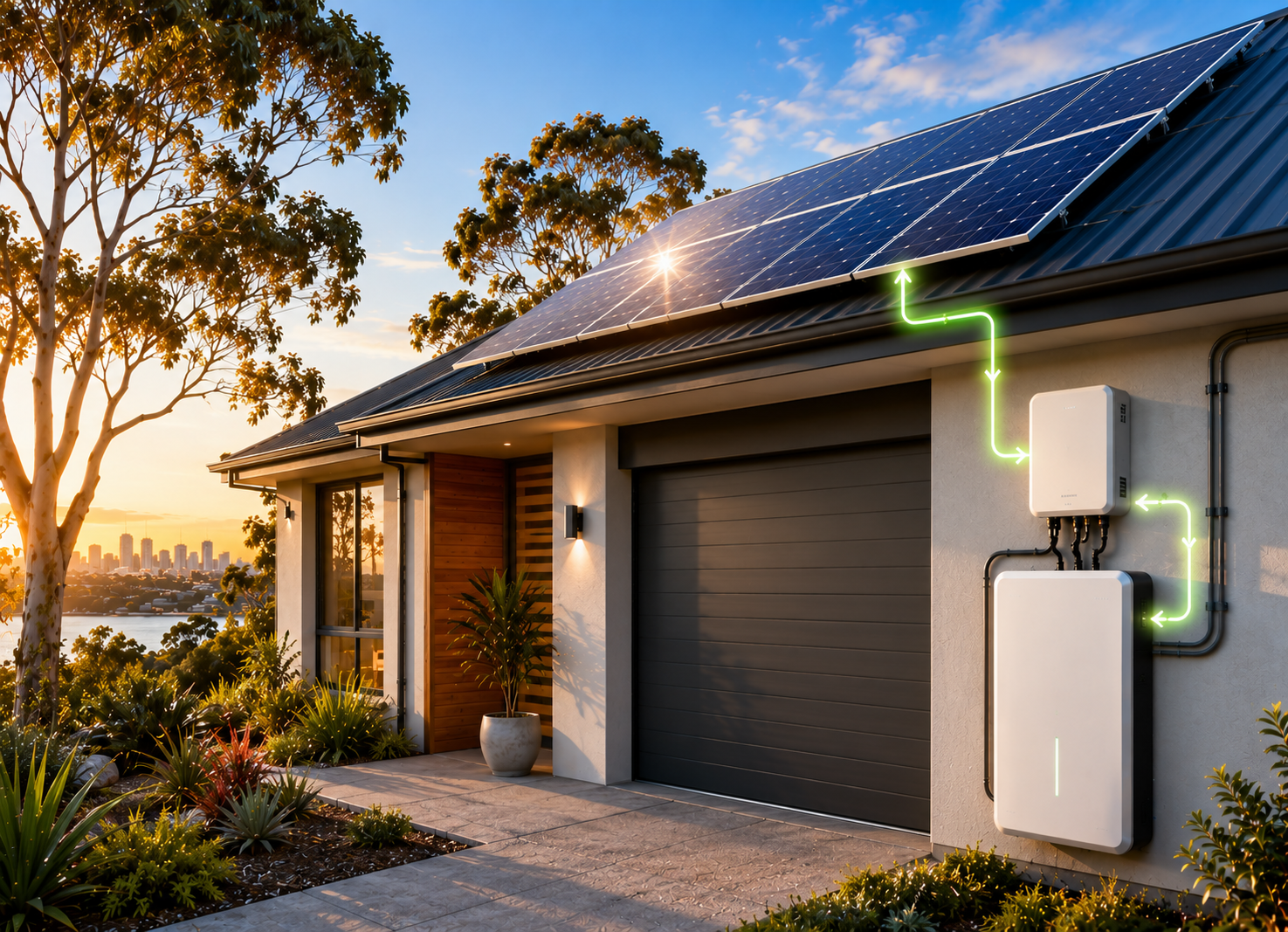
A solar battery is a storage system that captures excess electricity generated by your solar panels during the day. Instead of sending that unused power back to the grid for a very low feed-in tariff, the battery holds it so you can use it at night or during a power outage.
Here is a simple example. Your solar panels generate the most power between 10 am and 3 pm. Most families are at work or school during those hours, so that energy either goes to waste or gets exported to the grid for as little as 3 to 8 cents per kilowatt-hour. In the evening, when your family gets home and starts using appliances, you buy that power back from the grid at 30 to 45 cents per kilowatt-hour.
A battery fixes that problem entirely. It stores the cheap daytime solar energy and releases it when your household needs it most. The result is a dramatically lower electricity bill every single quarter.
Is Solar Battery Worth It in Australia in 2026?
Yes, solar battery storage is absolutely worth it for Australian homeowners in 2026, particularly if you use most of your electricity in the evenings. Solar battery storage is definitely worth it if you generate excess solar energy and use most of your energy in the evenings when the sun is down.
The financial case has never been stronger. Upfront costs have dropped to around $1,000 per kWh installed, and the new federal rebate of roughly 30% plus state incentives have shortened typical payback periods to around five to ten years in many scenarios, often within the battery’s warranty life.
Also, the gap between what you pay for grid power and what you earn from solar exports has never been wider. Feed-in tariffs across states like Victoria and NSW have dropped significantly, often hovering between 3 cents and 8 cents per kWh, while peak evening grid prices can exceed 35 to 45 cents per kWh. Every kilowatt-hour you store and use at night saves you roughly 30 cents, whereas selling it only earns you about 5 cents. This six-times value difference is the primary engine of your battery’s payback.
Why Australian Households Are Making the Switch
The momentum behind solar batteries in Australia is undeniable. In 2025, there was a major boom in solar battery storage adoption with the announcement of the federal battery subsidy, designed to make energy storage more affordable for more Australians. Total batteries installed passed 145,000 units nationally, with a combined capacity of 3,398 megawatt-hours.
Beyond the financial returns, Australian homeowners also value backup power during blackouts, greater energy independence, and the environmental benefit of using clean energy around the clock. These are real, tangible advantages that a solar panel system alone cannot deliver.
How Much Does a Solar Battery Cost in Australia?
Understanding solar battery prices is an important first step before deciding if it is right for your home.
The average solar battery price in Australia in 2025 sits between $800 and $1,200 per kilowatt-hour installed. For a standard 10 kWh system, you will typically pay between $8,000 and $12,000 installed. However, those prices are before rebates. After the federal government’s Cheaper Home Batteries Program is applied, the cost drops significantly.
In Sydney, NSW, the current cost of a 10 kW solar battery paired with a 6.6 kW solar panel system ranges from $13,000 to $13,500, and the potential payback time for this system can be as short as four years.
The Tesla Powerwall 3, one of the most popular batteries in Australia, stores 13.5 kWh and costs approximately $1,150 per kilowatt-hour before rebates. After the federal discount, the net cost becomes far more manageable for most homeowners.
Factors That Affect Solar Battery Price
Several things influence what you will actually pay for a solar battery installation:
Battery brand and model: Premium brands like Tesla, BYD, and Sungrow cost more upfront but often carry longer warranties and stronger performance guarantees.
Battery capacity: A larger battery stores more energy but costs more. Most Australian homes suit a 10 to 13.5 kWh battery, which covers most evening energy needs comfortably.
Inverter compatibility: If you already have a solar system, your current inverter may or may not be compatible with a battery. An incompatible inverter may need upgrading, which adds to the total cost.
Location and labour: Regional and remote installations may add extra travel or labour charges. Battery costs also vary across Australian states due to different market demands, installation availability, and government incentives.
Switchboard upgrades: Some older homes need switchboard work to safely accommodate a battery system, which adds to the installation cost.
Is Solar Battery Worth It Financially? Understanding the Payback Period
The payback period is the number of years it takes for your electricity savings to equal the upfront cost of the battery. After that point, the energy stored in your battery is essentially free.
For most Australian homes, the payback period for a solar battery now ranges between five and ten years. However, high-consumption households, especially those with electric vehicles, or those in states with aggressive incentives can see break-even points as low as three to four years.
Annual bill savings of $800 to $1,000 are common for a household with a 10 kWh battery. That is a meaningful reduction on your power bills every year, and as electricity prices continue to rise, those savings increase year after year.
It is also worth remembering that most premium batteries come with a 10-year warranty and are designed to last 10 to 15 years. Therefore, even a seven or eight-year payback period leaves you with several years of pure savings.
How to Calculate Your Solar Battery Payback Period
You can work out your personal payback period with a straightforward formula:
Payback Period (Years) = Net System Cost After Rebates ÷ Annual Bill Savings + VPP Income
For example, if you spend $12,000 on a solar battery system and your combined savings from using stored solar energy and available rebates amount to $2,000 per year, your payback period would be approximately six years. After that point, the electricity you use from your solar battery is essentially free.
Several free online calculators, including the SunSPOT tool and Solar Choice’s battery calculator, let you input your specific electricity usage, location, and tariff to get a personalised estimate. These tools make it easy to see whether a battery makes financial sense for your home before you commit to anything.
Solar Battery Rebates and Government Incentives in Australia
Government incentives have transformed the economics of solar batteries in Australia. The rebates now available make it significantly easier for homeowners to justify the investment.
Federal Cheaper Home Batteries Program
The Australian Government’s solar battery rebate began on 1 July 2025. It is a government discount that comes off the battery price upfront when you buy an eligible home battery, intended to cover roughly 30% of the cost.
The federal Cheaper Home Batteries Program provides a point-of-sale discount of approximately $372 per usable kWh, applied to the first 50 kWh per household. For a 10 kWh battery, that is approximately $3,720. For a 13.5 kWh Tesla Powerwall 3, it is approximately $5,022. The discount is applied by your installer so you do not need to claim it separately.
Importantly, from 1 May 2026, the Government announced changes to this Cheaper Home Batteries Program, including increased program funding from $2.3 billion to $7.2 billion. This expansion signals a long-term commitment to making battery storage accessible for all Australians.
State-by-State Solar Battery Rebates
In addition to the federal program, several state governments offer their own battery incentives that can be stacked on top of the federal discount.
New South Wales: NSW offers an additional rebate for connecting a battery to a Virtual Power Plant (VPP). The NSW incentive provides a rebate of up to $1,500 for connecting an existing battery or a new one to a VPP. This stacks on top of the federal rebate, making NSW one of the most financially rewarding states for battery owners.
Victoria: Victoria’s Solar Homes Program still provides solar panel rebates, though the Victorian battery loan program has closed, meaning most battery support in Victoria now comes through the federal battery rebate. Victorian households can still access the $1,400 solar panel rebate when installing a hybrid system.
Western Australia: WA households are eligible for a new home battery rebate under the WA Residential Battery Scheme. State-based rebates are up to $1,300 for Synergy customers and up to $3,800 for Horizon Power customers, and these can be combined with the federal rebate for even greater savings.
Queensland: Unfortunately, the Queensland Battery Booster program has closed and state-level battery rebates are no longer available. However, Queensland residents can still access the full federal Cheaper Home Batteries Program discount.
South Australia: SA households can access the federal home battery rebate provided they meet the scheme’s eligibility guidelines. South Australia also has a mature solar and storage market with a wide range of accredited installers.
Is Solar Battery Worth It in Melbourne and Victoria?
Melbourne homeowners often ask whether a solar battery is worth it given Victoria’s variable weather. The answer is still yes, and here is why.
In Victoria’s climate, solar batteries help balance energy use across distinct seasons. In summer, batteries charge efficiently during long daylight hours, storing surplus energy to offset evening air conditioning costs. In winter, they optimise limited solar generation during shorter, cloudier days and provide reliable backup during winter storms.
Melbourne households with high evening electricity usage, such as families running reverse-cycle air conditioning, dishwashers, and washing machines after 5 pm, benefit the most from battery storage. With Victoria’s feed-in tariffs now at some of their lowest levels in history and grid power prices remaining high, the financial case for Melbourne homeowners is stronger than it has been in years.
The fact that Victoria’s state battery loan program has closed means Melbourne homeowners should act quickly to take full advantage of the federal rebate while it remains at its current level. The STC discount is designed to reduce over time, so early movers get the best deal.
Is a Tesla Solar Battery Worth It in Australia?
Tesla’s Powerwall 3 is one of the most popular solar battery choices in Australia, and for good reason. It offers 13.5 kWh of usable storage capacity, a built-in inverter, seamless home backup capability, and a 10-year performance warranty.
The Tesla Powerwall, with a storage capacity of 13.5 kWh, costs approximately $1,150 per kilowatt-hour. After applying the federal rebate of approximately $5,000, the net cost becomes considerably more reasonable for most households.
So is the Tesla solar battery worth it? For many Australian homeowners, yes. The Powerwall 3 is particularly well-suited to households that want whole-home backup during blackouts, a sleek and compact design, and integration with Tesla’s energy monitoring app. If your home uses more than 12 kWh in the evening on average, the Powerwall 3’s capacity means you will rarely, if ever, need to draw from the grid overnight.
Therefore, if you can absorb the upfront cost and your home has solid evening energy usage, the Tesla Powerwall 3 offers one of the best long-term returns of any battery on the Australian market.
When Is a Solar Battery Worth It – and When Is It Not?
A solar battery is worth it in the following situations:
You use most of your electricity in the evenings or at night. This is the single biggest factor. The greater your evening energy usage, the faster your payback period will be.
You have a large solar panel system. A 6.6 kW or larger solar system generates more excess energy during the day, which gives the battery more to work with.
You are paying high grid electricity rates. If your tariff is above 30 cents per kilowatt-hour, storing your own solar energy instead of buying from the grid generates strong savings.
You live in a state with good rebates. NSW, WA, and Victoria all offer incentives that reduce your upfront cost significantly.
You value blackout protection. Purchasing a solar battery is not always necessarily a financial decision. Batteries have many other benefits including battery backup power. For families with home offices, medical equipment, or young children, uninterrupted power during outages is priceless.
However, a battery may not be the best choice if your payback period stretches beyond ten years. This can happen if you have very low evening energy usage, your home has a small solar system, or you are on a time-of-use tariff that already optimises your energy costs. Going fully off-grid with just a battery and solar is often not financially worth it because you need a very large battery and possibly a backup generator for reliability. Most people find staying grid-connected with a battery is more economical and practical unless they are in a remote area where grid connection is costly.
Virtual Power Plants (VPPs): An Extra Way to Save
A Virtual Power Plant, or VPP, is a network of home batteries that are managed together to support the electricity grid during times of high demand. When you join a VPP, your energy retailer can briefly draw on your stored power during grid emergencies, and in return, you earn credits or cash payments.
Many retailers now pay battery owners between $100 and $250 per year to occasionally borrow the battery during grid emergencies. This can shave 12 to 18 months off your payback period.
In NSW, connecting to a VPP also unlocks additional government rebates. NSW’s Peak Demand Reduction Scheme can stack with the federal Cheaper Home Batteries Program for eligible VPP participants, with a potential combined rebate of $6,000 to $8,000.
For homeowners who want to maximise their financial returns, enrolling in a VPP program after installation is one of the smartest moves you can make. It costs you nothing, requires no lifestyle changes, and generates ongoing income from your existing battery asset.
Is Solar Battery Worth It? A Simple Checklist for Australian Homeowners
Before you commit to a purchase, ask yourself these questions:
Do I use most of my electricity in the evening or at night? If yes, a battery will deliver strong savings immediately.
Is my solar system large enough to generate excess energy during the day? A 5 kW system or larger is generally ideal for battery pairing.
What is my current electricity tariff? If you are paying more than 30 cents per kWh, your savings will be significant.
Am I eligible for federal and state rebates? Almost all Australian homeowners are eligible for the federal Cheaper Home Batteries Program. Check your state for additional incentives.
How long do I plan to stay in my home? A battery is a long-term investment. If you plan to stay for at least eight to ten years, the payback period is well within reach. It can also add value to your property for resale.
Do I want blackout protection? If reliability during outages matters to your family, a battery with backup functionality is worth it for peace of mind alone.
If you answered yes to three or more of those questions, a solar battery is almost certainly worth it for your home.
Conclusion
So, is solar battery worth it? For the vast majority of Australian homeowners in 2026, the answer is a clear yes. Electricity prices are high, feed-in tariffs are low, and the federal government is now offering the biggest battery incentives Australia has ever seen.
With payback periods now ranging from five to ten years, annual savings of up to $1,000, and the added bonus of blackout protection and VPP income, a solar battery is no longer just a lifestyle upgrade. It is a genuine financial investment that pays for itself within the life of the warranty.
The key is to assess your own household energy usage, get quotes from multiple accredited installers, and act while the current federal rebates are still at their most generous level. The STC discount is scheduled to reduce over time, so the sooner you install, the better value you will receive.
Ready to take the next step? Contact an accredited solar installer today and find out exactly how much you could save with a solar battery tailored to your home.
Frequently Asked Questions
How long does a solar battery last in Australia?
Most quality solar batteries last between 10 and 15 years, and most premium brands offer a 10-year warranty. This means the battery will likely outlast its payback period by several years, delivering pure savings in its final years of operation.
Can I add a battery to my existing solar system?
Yes, in most cases. However, your current inverter needs to be compatible with battery storage. Some older inverters require upgrading to a hybrid inverter, which adds to the cost. A qualified installer can assess your current setup during a site visit.
What is the best solar battery in Australia in 2026?
The Tesla Powerwall 3, BYD Battery Box, and Sungrow SBR series are consistently rated among the best for Australian conditions. Each offers strong warranties, high efficiency, and compatibility with most solar inverters.
Is a solar battery worth it if I already get a feed-in tariff?
It depends on how much your feed-in tariff pays. If you are earning only 3 to 8 cents per kWh from your exported solar energy and paying 35 cents or more to buy it back at night, a battery is almost certainly worth it. The savings from self-consumption far outweigh what you earn from exporting to the grid.
Is solar battery worth it if I rent?
This is trickier, as renters generally cannot install a battery without their landlord’s consent. However, some landlords are now adding batteries as part of the Solar for Rentals program available in Victoria. If you own your home, the answer is much simpler: yes, it is worth it.